Getting safely between floors
When stairs become difficult
Difficulty on the stairs doesn't always mean that a stairlift is the only answer. The right choice depends on balance, strength, pain, breathlessness, vision and whether the person can sit down and stand up safely at both ends. The shape of the staircase and the space around it matter too.
First work out what is making the stairs hard
Someone who is steady but tires quickly has a different problem from somebody whose knee gives way without warning. A person with poor vision may struggle mainly with the edge of each tread, while a stroke survivor may have difficulty gripping a rail on one particular side. Notice where the difficulty begins, whether going up or down is worse and whether turning at a landing causes trouble. If there have been falls, near misses or sudden changes in mobility, ask for a professional assessment instead of experimenting on the staircase.
Rails, lighting and the condition of the stairs
A secure rail on both sides can help when there is enough width and the person can grip them. Rails need to continue far enough at the top and bottom to be useful without catching clothing. Check loose carpet, worn tread edges and items left on steps.
Strong, even lighting is particularly helpful at landings, where a shadow can disguise the final step. Contrasting tread edges may help some people with impaired vision, although heavily patterned carpet can make individual steps harder to judge.
Would a stairlift be usable at both ends?
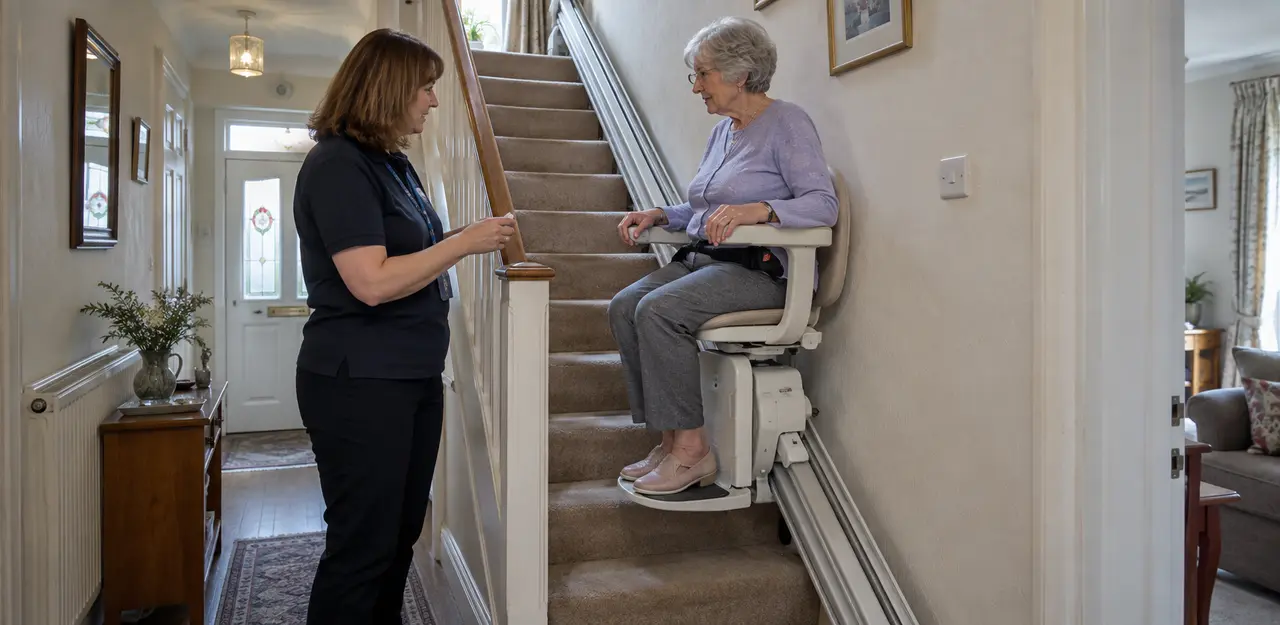
A stairlift works well for many people who can transfer onto the seat, remain seated and get off safely. Straight stairs normally use a standard rail. Curved stairs, bends and intermediate landings require a rail made for that staircase.
The top landing needs careful thought: swivelling the seat may allow the user to get off facing away from the drop. Also consider where a walking frame or wheelchair will be kept. If it is needed upstairs and downstairs, a second aid may be required.
When a home lift may make more sense
A through-floor home lift can carry a wheelchair user between two levels without a transfer, provided the model and layout are suitable. It takes floor space on both levels and normally involves structural openings, fire-safety measures, electrical work and making good.
Find out whether the quoted price includes surveys, building work, decoration, servicing and any changes to doors or radiators. Platform lifts can solve shorter changes of level, though the approach space and turning area still need checking.
Downstairs living is another option
A spare room may become a bedroom, but sleeping downstairs works properly only if washing and toilet facilities are accessible too. Think about privacy, heating, routes through doors and how the household uses the room now. An extension can provide a good long-term arrangement, although it is a building project instead of a quick adaptation. Compare the complete costs and disruption with a lift, stairlift or a possible move before deciding.
Get the choice checked in the actual house
Measurements, transfers and the user’s daily routine all affect the answer. An occupational therapist can help define the need without being tied to one product. If you are speaking to suppliers, ask for written quotations on the same basis so you can see what each price leaves out.
Try the seat, controls and transfer if a demonstration is available. Ask what happens during a power cut, how breakdowns are handled and how often servicing is needed. For a reconditioned stairlift, find out which parts are new, what warranty is included and whether the rail is made for the staircase.